Sunday, March 5, 2017

Sunday, September 4, 2016
Sunday, May 29, 2016
Tuesday, April 19, 2016
Wednesday, April 13, 2016
Monday, February 29, 2016
Fish Tank Basic Requirements
 When starting a fish tank, there are several key items needed to be successful. Those key items include: filtration, heating, good water quality and lighting.
Filtration: Filtration is in my belief the most important requirement when running a fish tank. Filtration in a tank provides clean, oxygenated water and also removes harmful ammonia and other chemicals. Without filtration, NO Aquarium can last; all the fish will die. Filtration makes it so that all fish can breath and that the water is clean. So filtration is the number one requirement when starting an aquarium. The most common form of filtration is external filters. External filters are filters that hang on the outside of a tank and sucks water through a tube cleaning it and providing oxygen. External filters are often the most common, followed by sponge filters, the canister filters. No matter what type of filter, it is mandatory to have some type of filtration to keep your fish alive and healthy.
Heating: When keeping a fish tank with tropical fish, it is very important to keep your fish tank at the correct temperature. Heating is only required with tropical fish, cold water fish like gold fish don’t require heaters. Now with tropical fish, if your tank is too cold for your fish your fish won’t be as active, they would be dull in colorful and would most likely die. Most tropical fish need a steady temperature between 78º-82º degrees. Anywhere lower could result in serious problems. With an aquarium heater, your tank can stay the temperature needed for your fish to thrive.
Good Water Quality: Good water quality in a fish tank is very essential. The same way we humans need clean, fresh air to live, is the same way fish need clean water with proper chemical balances. Fish produce a lot of waste that makes the water quality poor, introducing harmful bacteria like nitrite and ammonia which can kill fish. Having an aquarium filter takes care of a lot of that, but not all. It is important to do weekly water changes to keep the ammonia and nitrite levels out of the tank.
Another important thing to consider when seeking good water quality is making sure that your aquarium has the proper pH levels. Fish coming from all over the world have different pH requirements. Some fish require higher pH levels, while others require lower pH levels. It is important to know the required pH level of all of your fish. You can check the pH level of your tank using a pH tester kit which is available at most fish stores. It is central that you assure your tank has good water qualities to keep your fish healthy and happy.
Lighting: Lighting in a fish tank is necessary if you want a tank to have natural affects that would occur in the wild like algae growth. Most people recommend aquarium fluorescent lights, which have a similar effect as the sun, growing algae which feeds tank algae eaters like snails and algae eating fish. Fluorescent lights also have a way of high lighting colors on fish. Some people do use others lights not meant for aquariums with no consequences, however it takes away that “natural feeling” in the tank!
Sunday, February 14, 2016
Saturday, January 23, 2016
Keeping Predatory Fish
 Keeping predatory fish in an aquarium can be very entertaining! Predator fish are fish that naturally survive on hunting for meals, fish with carnivorous attitudes! Keeping fish that live in such a way can be amusing to watch how fish naturally survive, however, you need to make sure that their appetite is controlled. Predatory fish tend to be more aggressive due to their want to eat, so care for them is very important!
Most people when its come to housing predatory fish, prefer to feed their fish pellets foods that contain meatier ingredients. This tends to be the most recommended way because its more healthier and it can ease aggression!
Another option when feeding predatory fish is live food. Mostly all predatory fish will love to devourer live foods like worms, crickets, and other insects! There also are feeder fish available to feed predatory fish; live smaller fish (commonly goldfish and minnows).
 When feeding your fish live food, it can cause more aggression in your tank. Also feeding your fish live fish may cause your fish to turn on each other! So live food will be accepted by your fish, but may have some negative results.
To top it all off, predatory fish can be great fish to keep. I wouldn't recommend them for beginners due to attitudes and appetites, but they would make a great pet for experienced fish keepers.

Friday, January 15, 2016
Sunday, January 10, 2016
Tuesday, December 22, 2015
Maylandia Zebra "Makonde"
 |
| 3 Inche Male |
Type: Mbuna cichlid
Origin: Lake Malawi Africa
Size: 6 inches
Color: Males hold the beauty in this species, displaying bright cobalt blue colors with black outlined fins! Females are not as colorful and are more dull!
Description: This is another incredible beautiful mbuna cichlids...and like all mbuna it carries a bad attitude toward other fish especially of its own kind or similar looking to itself! The higher ranking male will generally display most color!


Friday, November 13, 2015
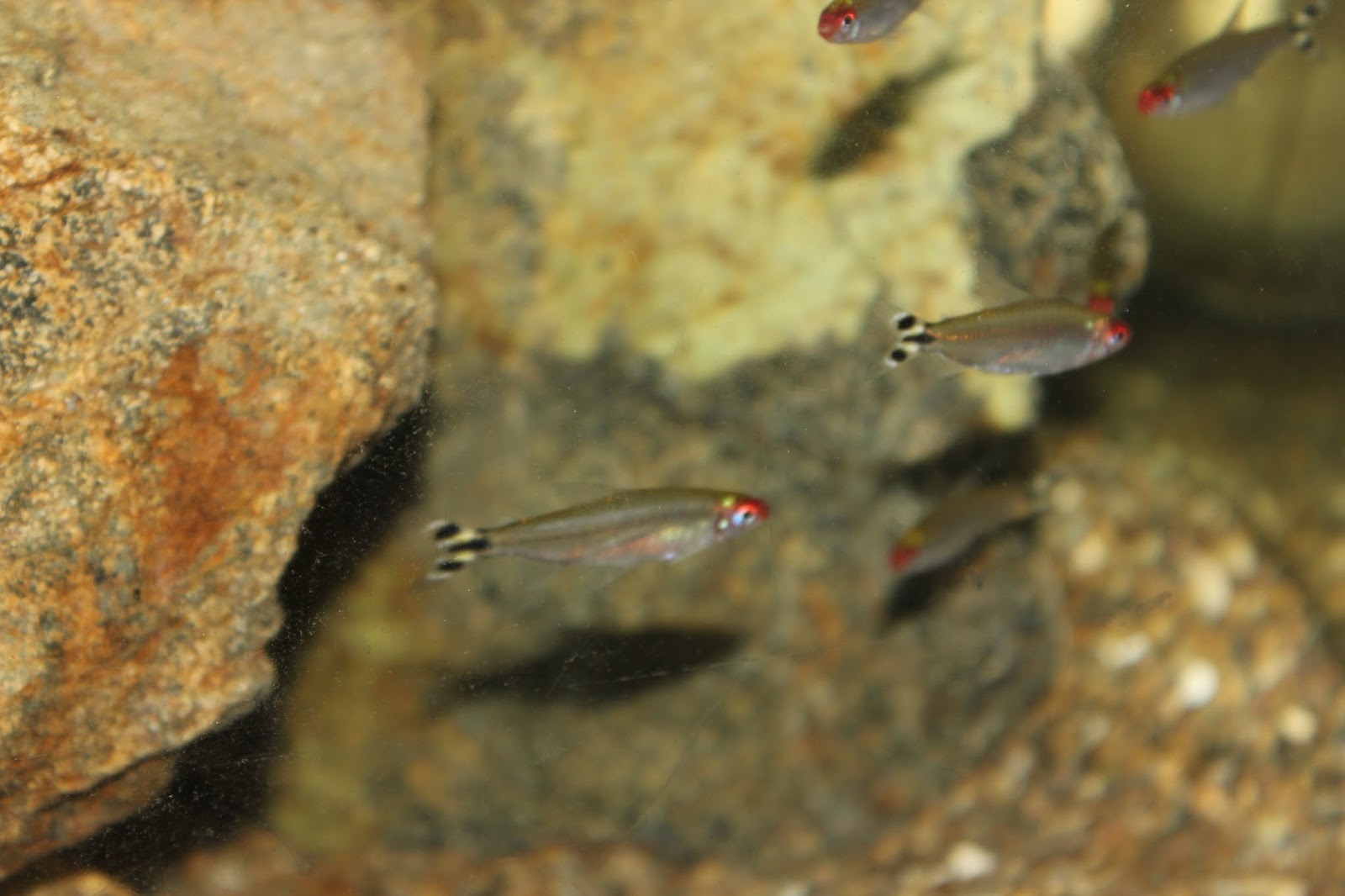
Hemigrammus Rhodostomus

Type: Tetra
Origin: South America
Size: 2 inches
Color: Rummy Nose Tetra are known for their red faces....thus the name! Their red faces show beautifully on their silver bodies!
Description: Rummy Nose Tetra are a beautiful schooling fish well fitted for the planted aquarium bringing fast moving reds in the greenery of the plants! These fish swim tight together making them even more enjoyable to watch!



Thursday, October 29, 2015
Barbonymus Schwanenfeldii
 |
| 2 Red Tail tinfoil barbs |
Type: Barb
Origin: Asia
Size: 8-12 inches
Color:Tin foil barbs are large silver to bronze colored fish with bright red to orange tails. Their are a few different varieties or color ranging from the albino as seen in the photo above, the standard which is under the albino in the picture, and a few more differences in tail colors and scale tones!
Description: Tin foil barbs are some of the largest growing barbs! Their are a few different species of tinfoil barbs, the most common include the red tail, the golden tinfoil barb and the standard tinfoil barb ( the largest). These fish grow very large very fast and are a schooling fish so a decent tank size with plenty of swimming room is required! When given the appropriate care....tinfoil barbs can be very beautiful relaxing fish to watch!


Wednesday, October 14, 2015
Moenkhausia Sanctaefilomenae

Type: Tetra
Origin: South America
Size: 3 inches
Color: Lamp eye tetra generally show a silver body with a bright red ring around eye and a black ring before anal fin! Sometimes these fish can display an extra green to red coloration along top of body witch can be seen in the picture below!
Description: Lamp Eye tetra are an excellent schooling fish they bring loots of excitement to most aquariums. These fish spend a lot of time socializing with their own species...like most tetra!


Saturday, October 3, 2015
Trigonostigma Heteromorpha

Type: Rasbora, Cyprinidae
Origin: Asia
Size: 1 1/2 inches
Color: Harlequin Rasbora display a beautiful orange to pinkish body with a black marking from stomach to anal fin!
Description:The Harlequin Rasbora is definitely one of the top aquarium schooling fish available! These beautiful fish are very dependent on one another thus displaying amazing school behavior! Their bright coloration would make them look stunning in any community aquarium!


Sunday, September 27, 2015
Devario Aequipinnatus
 |
| Click here For Video |
Type: Cyprinidae, Minnow
Origin: India
Size:4 inches
Color: Giant Danio display a green to blue color on the sides of their body over a silver base with yellow markings going across the green!
Description: Giant Danio are some of the most active aquarium available! These fish are always on the move and overall very entertaining! To add these fish are some of the best schooling fish to keep because they trust one another for comfort and safety!


Tuesday, September 22, 2015
Fish Stress
Fish Stress is the Number 1 cause of problems in fish keeping!
The same way humans stress over different situations in life, is the same way fish stress over situations in their life, and I think that that have a lot more reasons to stress than we have; being that they are held captive in glass boxes for our entertainment instead of living free in the rivers and lakes where they belong! However, there are many ways to relieve stress for your fish and to make your fish enjoy being with you!
 |
| Red Tail Giant Gourami |
Cause of Stress
Fish Stress is caused by a number of reasons. Below are some of the most common reasons:
Improper Water Quality: Having water that don't match your fish's requirement's in regards to pH, temperature, and others conditions that are found in fishes natural home!
Poor diet: Feeding fish food that is not supposed to be fed to it!
Tank Design: If you tank design is not comfortable for your fish providing hiding spots and safety retreats it can surely cause stress! My suggestion when choosing a tank design that is least stressful for your fish is to try to imitate your fishes natural habitat!
Over Crowding Tank: Too many fish in your tank!
Bullying: If your fish is being bullied by other fish stress is sure to come!
Poor filtration: If your tank is not being filtered and cleaned properly it can stress your fish out!
External Stress: People tapping glass, putting hands in tank, chasing fish with net, etc.!


Signs Of Stress
When your fish are stressed, they will not keep it a secret from your, they always show signs of stress! However, some signs are easier to notice than others.- Hiding: Often times fish hide when stressed!
- Not Eating
- Diseased or sick
- Torn fins
- Lack of color
- Lack of activity
Prevention Of Stress
There are many things to do to prevent stress:
- Make sure you have good water quality, meeting all needs and requirement of your fish!
- Make you fish comfortable, provide hiding spots and many things than imitate fish's natural environment like rocks and plants:
- Prevent bulling, removed all bullying, or bullied fish!
- Feed You Fish the appropriate diet for your fish!
- Be sure to have Perfect Filtration!
- Keeping Children from tapping on glass and bothering the tank!

Saturday, August 22, 2015
Dither Fish
Sometimes we go after a fish that we can imagine would be a great pet, but when it come's home we find that it is not what we had planed! Sometimes fish that seem cool in the fish store can become very shy at home or very aggressive; and that's where dither fish come in! Dither fish are fish that you can add to an aquarium that may have a fish that's too shy or too aggressive! Dither fish are meant to bring comfort to a fish that may be hiding a lot, or if there is bullying in a tank dither fish can help spread that aggression! Dither fish are not a specific group of fish, they can really be any type of fish!
An example of how dither fish can be used is with my Large Red Devil cichlid, he's very shy and hides a lot! I introduced some Giant Danio so that the spotlight was not on him completely, and now he's more comfortable! Dither fish are great because they can help bring more action from your main fish, while not taking too much attention away from them!
Now as I said before any type of fish can be used as a dither fish, however from my experience the best dither fish are fish that are very fast (in the situation of being used to to reduce aggression) and fish that school together (School Behavior keeps them safer)! Also of the main fish in your tank is a large fish be sure to use dithers that are not small enough to be eaten! Another crucial element for dither fish is that they must be fish that don't like to hide, fish the swim freely in the center of the tank!
Here's a list of my favorite dithers starting with small dithers for small situations: danio, tiger barbs, gold barbs, black shirt tetra, rummy nose tetra and other small tetra and barbs!
Medium size dither fish include: spotted silver dollars, giant danio, roseline sharks, spotted silver dollars and clown loaches ( only if in large schools, smaller schools will hide more)
Large dither fish include larger species of silver dollars like wide bar silver dollars, tinfoil barbs and filament barb!


An example of how dither fish can be used is with my Large Red Devil cichlid, he's very shy and hides a lot! I introduced some Giant Danio so that the spotlight was not on him completely, and now he's more comfortable! Dither fish are great because they can help bring more action from your main fish, while not taking too much attention away from them!
Now as I said before any type of fish can be used as a dither fish, however from my experience the best dither fish are fish that are very fast (in the situation of being used to to reduce aggression) and fish that school together (School Behavior keeps them safer)! Also of the main fish in your tank is a large fish be sure to use dithers that are not small enough to be eaten! Another crucial element for dither fish is that they must be fish that don't like to hide, fish the swim freely in the center of the tank!
Here's a list of my favorite dithers starting with small dithers for small situations: danio, tiger barbs, gold barbs, black shirt tetra, rummy nose tetra and other small tetra and barbs!
Medium size dither fish include: spotted silver dollars, giant danio, roseline sharks, spotted silver dollars and clown loaches ( only if in large schools, smaller schools will hide more)
Large dither fish include larger species of silver dollars like wide bar silver dollars, tinfoil barbs and filament barb!


Subscribe to:
Posts (Atom)